
18 Toxic Friendship Signs + What to Do About Them
What is a toxic friend?
While every friend will have weaknesses and occasional bad days, a toxic friend has an overall bad vibe. They’ll take without giving, make everything about them, criticize and suck the life out of you, and make you wonder why you’re friends in the first place.
The good news is that there are loads of toxic friendship signs you can watch for to ensure your friendships remain healthy, balanced, and positive.
Signs of a Toxic Friendship
Toxic traits leave recipients feeling drained and confused about where they stand, both with the toxic person and the world at large. That's why recognizing the warning signs of toxic behavior is essential for your mental health and well-being.
So…what are the signs of a toxic friendship?
If you experience three or more of these toxic friendship signs, you may be dealing with a truly toxic friend. Consider them red flags!
It’s all about them.
Toxic people will leave you giving way more than you receive. Their motto will unofficially be, “What’s yours is mine and what’s mine is mine.”
And you can never talk about yourself for longer than a minute or two before they redirect the conversation back to themselves.
You just started dating someone wonderful? Let me tell you about how amazing my boyfriend is!
Your child scored a touchdown? Ahh, that reminds me of my kid’s time in football…
They’re always the victim.
Everyone in their life has wronged them…or so they’ll tell you. While some people have truly lived miserable lives of pain and loss, a toxic person has done no wrong…ever.
They were a perfect, attentive husband at all times…but their ex-wife was a crazy witch. They selflessly sacrificed everything to help their friends…but their friends abandoned them.
And the fact that they nearly ate and drank themselves to death has nothing to do with the poor health they’re in now. They were cursed with bad genes!
Even unrelated circumstances, like the weather, can be blamed. “Of course, it would rain now. This always happens to me.”
There’s consistent drama.
While even good friendships are bound to face conflict and the occasional bad day, a toxic friendship can never quite escape it.
You’ll often find that just the sight of their name on a text will induce immediate stress as you wonder, “What now?” And more often than not, you’ll leave their presence feeling worse than when you arrived.
They constantly put you down.
Another sign of a truly toxic friend is that you will never do or say anything right in their mind.
They’ll criticize what you do and how you do it. Even if you’re doing something in an acceptable way, they’ll often believe that their way is the only right way to do it…and insist you follow suit.
They might even compare you to others to pressure you to do the things they want.
So-and-so goes to a dance class with her friend; she’s so supportive! And what’s-her-name is always running little errands for her best friends…must be nice!
This is one of the most obvious warning signs of toxic behavior.
They try to change who you are as a person.
A true friend will encourage you to be the best version of yourself. They want to see you living your best life.
This is one of the good things, if not the best thing, about a healthy friendship! But a toxic friend will encourage you to be someone you’re not.
They’ll insist you dress differently, act differently than your natural disposition, or even take up interests and hobbies that you don’t care about, or might even dislike, for their sake. While a true friend appreciates what makes you, you, a toxic person will insist on “improving” you to better suit their needs.
They don’t respect you or your boundaries.
The Oxford dictionary defines respect as “due regard for the feelings, wishes, rights, or traditions of others.”
A real friend will respect these things, as well as any healthy boundaries you set to protect your time, energy, and well-being. Toxic friends will not only disrespect you but call your boundaries selfish.
They don't support you.
A real friend will always have your best interests at heart. They'll be your cheerleader, not someone who makes you doubt your worth.
If you find your successes are met with indifference or cynicism rather than celebration and encouragement, it may indicate a lack of support. A true friend will resonate your happiness and back you in your endeavors, sowing seeds of confidence rather than doubt.
They can’t be trusted.
You may feel guarded when communicating with toxic people, knowing that anything you say can and will be used against you…or shared with others, even if you note that it’s private. You can speak freely within healthy relationships, knowing a real friend has your best interests at heart and won’t judge, manipulate, or betray you.
They need all of your attention. All of it!
Toxic friendships are usually codependent, which means the majority of their emotional and psychological reliance falls on…you!
They need you to be available to them at all times…pick up when they call, reply immediately when they text, and drop your plans to do whatever they want to do whenever they want to do it. It’s an unhealthy relationship that will leave you feeling suffocated.
But interestingly enough, they often don’t play their part as mutual friends. They don't return the on-call status when you need them, won’t be bothered to return your texts if they’re in the middle of something, and certainly don’t have the bandwidth to make themselves available to someone else’s plans or schedule.
They get jealous of other people in your life.
Because they want all of your time, toxic people won’t like any other people who text, call, or spend time with you, whether a close friend, romantic relationships, or even family members.
They’ll ask who it was that just texted you and will find something to criticize about the other people in your life. If they “just have a bad feeling” about another person, they can even spin it as if they’re looking out for you!
They always try to one-up you.
In healthy relationships, friends encourage one another and celebrate each other’s victories. A true friend sincerely wants to see you living your best life.
But a toxic friend will always view you as their competition. This is a more subtle, yet telling, sign of unhealthy friendships.
They’ll struggle to celebrate your successes and the good things that happen to you without turning the spotlight back on themselves. And if you do one-up them, they’ll take a passionate stance that the thing you just accomplished isn’t important…or that it’s even negative.
They're dishonest and manipulative.
Honesty and trust are at the foundation of healthy relationships. So watch out for patterns of lying, manipulation, and gaslighting.
These behaviors can undermine your reality, shaking your trust and self-esteem. If a close friend continually crosses your boundaries or uses shame as a tool, it's a sign that the relationship lacks the mutual respect necessary for healthy relationships.
They rarely apologize.
As noted above, a toxic person has trouble seeing their own faults and therefore, hesitates to apologize. If they do apologize, it’s often in a way that redirects the blame back to you.
I’m sorry I said that, but you had to have known that would upset me! I wish you’d be more considerate in the way you word things to me.
They gossip regularly.
If they gossip about everyone else in their lives, there’s a huge chance they also gossip about you. Regularly cutting other people down is a strong indicator of a truly toxic friend.
They’re unpredictable and leave you feeling on edge.
Toxic people are wild cards.
Maybe they were sincere when they said that thing…or maybe they were being sarcastic and are now planning your demise. In toxic relationships, you sincerely believe your friend could go either way and are often nervous to learn their true intentions.
They leave you feeling emotionally drained.
Healthy relationships should leave you feeling energized, not depleted. If you're consistently feeling drained or are carrying emotional heaviness after interacting with a close friend, these are red flags.
Healthy friendships enhance your energy levels and joy, but toxic friends in an unhealthy relationship will consistently give you a hard time. They can saturate your days with negativity, leading to stress and anxiety.
You blame yourself and feel responsible for their behavior.
In an unhealthy relationship, the toxic person will shift the blame for their negative behaviors onto you.
They’ll make you believe that if only you would have said or done things differently and better, they would have responded more positively. It’s actually your fault they blew up at you!
They may also leave you cleaning up their messes with others.
They’ll treat other people terribly, then leave you to explain that they’re going through a lot and didn’t really mean that. You may also find yourself regularly lying and/or covering for them.
These are red flags that shouldn't be ignored!
Something just doesn’t feel right.
The best thing you can do for your own emotional health is to trust your gut! If you feel trapped or obligated to be their best friend…if you don’t look forward to seeing them and are happy when your plans together are canceled…or if you constantly feel drained and on edge…you’re probably in a toxic relationship.

Impacts of Participating in Toxic Relationships
Maybe you know you have a toxic friend, but you’re not quite convinced it’s all that bad. After all, you always have someone to hang out with, and having a hard time with a toxic friend is better than having no friend at all, right?
But the impacts of toxic relationships are pretty…well…impactful. Toxic friendships can significantly impact both your mental and physical health.
Impact on Mental and Emotional Health
Toxic friendships can lead to increased feelings of depression and anxiety. You might find yourself feeling more drained than uplifted after interactions.
Your self-esteem could suffer, and you may notice that you have a less positive outlook on life. Empathy for others may also be affected since dealing with a toxic friend can leave you feeling emotionally exhausted, making it challenging to support others.
Influence on Physical Health
Beyond your emotional health, toxic relationships can also influence your physical health. The stress associated with an unhealthy relationship may contribute to high blood pressure.
Your immunity could be weakened due to the continuous stress hormones circulating in your body, potentially resulting in more frequent illnesses. Prolonged exposure to toxic friendships can even shorten your lifespan!
If you notice that your physical health is declining without a clear cause, consider evaluating your social connections.
How to Heal From a Toxic Friendship
Once you’ve identified toxic friendship signs, how can you heal and move forward?
Generously apply space and healthy boundaries.
It’s easiest to fairly assess a relationship when you’re not in the thick of it. The best thing you can do is to give yourself a bit of space and time away from your friend to reflect on your relationship and decide what boundaries you want and need to set.
Set healthy boundaries.
Actually setting your desired boundaries with a toxic person is often the hardest part.
They’ll tell you that you’re being way too dramatic and over-reacting. They might insist that your boundaries aren’t reasonable or fair.
They may even accuse you of acting selfishly.
This is why you’ll want to speak directly and assertively, responding to interruptions and arguments with the same few bullet points over and over until your friend realizes you don’t plan to engage in their emotional hijacking or gaslighting attempts. It may help to practice what you plan to say by yourself or with a good friend or family member before you approach your friend.
Prepare to part ways with your toxic friend if and when necessary.
Once they’re informed of your boundaries, it is up to your friend to decide if they will abide by and respect them in order to salvage the relationship…or if they won’t.
As a recovered people pleaser, I felt both terrified and liberated when I informed a toxic friend, “You can either respect my boundaries or we can end our friendship, no hard feelings. I would understand if those boundaries didn’t work for you and I would respect your decision.”
Take some time to think through the conversation and logistics of “breaking up” with your friend ahead of time so that you’re not thrown off guard if/when it comes time to part ways. (And if it does come to that, be sure to check out this post on how to heal when a friendship ends.)
Rekindle old friendships and make new ones.
Whether you remain friends or not, it’s important that your entire social life doesn’t depend on just one person. You certainly don’t need to have several best friends, but be sure that you’re regularly communicating and spending time with several different people.
I have some friends I meet up with monthly, some I text throughout the week, some I chat with at church and in the parent pickup line, and others I check in with every few months. Friendship is a lifeline that should be spread out over several people.
Take good care of yourself.
Taking the time to care for your physical, mental, and emotional health will keep you grounded even if and when your friends are not. And you know what they say…you can’t pour from an empty cup!
Recognize your personal value.
You are valuable, and your self-esteem shouldn't be tethered to those who don't recognize your worth. Start by:
- Reflecting on your strengths: List down your talents, skills, and the qualities that make you unique.
- Affirming your worth: Daily affirmations can reinforce your belief in yourself. Try statements like, "I am worthy of respect and kindness."
This process helps rebuild the esteem that may have been eroded by a one-sided friendship, and transitions your mindset to one that fully appreciates your inherent worth.
Work to develop resilience.
Facing and overcoming the challenges of toxic relationships builds resilience. Here's how you can foster this essential quality:
- Set healthy boundaries: Clearly define what is acceptable behavior and what isn't in healthy relationships.
- Seek supportive networks: Engage with friends and communities that uplift you and respect your boundaries.
Resilience isn't built overnight. It's a muscle you strengthen every day by standing up for yourself and knowing that setbacks are part of your growth journey. Your experiences have given you a unique perspective that you can now use to navigate life with a new sense of clarity.
Consider therapy.
No, I’m not referring to couple’s therapy with your friend! I mean, seek therapy for yourself with a clinical psychologist.
A therapist on TalkSpace helped me to realize how I was inadvertently creating and enabling toxic relationships through my own words and actions. By digging to the root of my own identity, self-esteem, and mental health, I was able to relate to others in a much healthier manner.

Toxic Friendship Signs FAQ
What causes toxic behavior?
It’s difficult to say! Many toxic friends don’t know how to address their own hurts and struggles in a healthy way and so project them onto others instead.
Others have grown up to believe that the toxic relationships of their parents and other family members are normal and expected. They’ve never seen an alternative, healthy relationship demonstrated.
No matter what the cause, the important thing to remember is that toxic behavior has nothing to do with you and everything to do with the toxic person.
Can a nice person be toxic?
A nice person can certainly be toxic. If they’ve grown up observing toxic relationships, they may be super kind and considerate and demand all of your attention, constantly compete with you, and gossip like it’s their job.
Being toxic doesn’t always mean that you’re angry and rude and throwing things at people. It means that you’re not actively contributing to healthy relationships.
Is the toxic person toxic to everyone?
Not necessarily! I once knew a toxic person who delivered toxicity to her husband and children, but readily received it from her father.
Toxic people will often treat others in whatever way those people will accept treatment.
So if others accept an unhealthy relationship, that person will play the part of the toxic friend. But if someone sets healthy boundaries and refuses mistreatment, the toxic person will treat them with more respect.
Why do I attract toxic people?
Toxic people need those who will accept their toxic behavior. So if you struggle to set boundaries and readily take responsibility for others’ actions, you’re a solid candidate in their (likely subconscious) eyes.
This is another reason that I strongly recommend looking into counseling with a clinical psychologist.
It was there that I learned that many of the behaviors I was receiving from others were actually behaviors that I was allowing. My therapist helped me to set clear and direct boundaries to take back control of a large part of my life.
What are the subtle signs that indicate a friendship might be harmful?
Subtle signs of unhealthy friendships include feeling like you're walking on eggshells, experiencing a one-sided dynamic where your efforts aren't reciprocated, or sensing that your friend is envious rather than happy for your successes.
What strategies can be used to manage interactions with a difficult friend?
Limiting your availability and setting clear boundaries can help manage interactions. It's also helpful to be direct about your feelings and the impact of their negative behaviors on you.
How do you know if you're responding appropriately or overreacting to a friend's negative behaviors?
Evaluate the situation by considering if there's a pattern of negative behaviors.
Talk to someone you trust for perspective, and trust your feelings. If your well-being is compromised, your reaction is justified!
What are the traits of toxic romantic relationships?
Toxic romantic relationships can be harmful to one's emotional, psychological, and sometimes physical well-being.
The signs of toxic romantic relationships are very similar to toxic friendships. Recognizing the toxic traits of such relationships is crucial in addressing the issues or deciding to leave the relationship for your safety and happiness.
Here are some common traits of toxic romantic relationships:
- Lack of Trust: Constant suspicion, jealousy without cause, and a general lack of trust pervade the relationship.
- Controlling Behavior: One partner may try to control where the other goes, whom they see, what they wear, or even how they spend their time and money.
- Dependency: One partner may be overly dependent on the other for emotional support, financial stability, or self-worth, often to an unhealthy degree.
- Poor Communication: Communication is marked by frequent misunderstandings, refusal to discuss issues, passive-aggressive behavior, or an inability to express feelings and needs healthily.
- Disrespect: This can manifest through belittling, name-calling, mocking, or other forms of verbal abuse that can chip away at a person’s self-esteem.
- Manipulation: Emotional manipulation is common, where one partner may use feelings of guilt, shame, or the fear of losing the relationship to control the other.
- Isolation: One partner may try to isolate the other from their friends, family, or social support networks.
- Frequent Arguments: While disagreements are normal and even inevitable in romantic relationships, constant arguing, especially over trivial matters, and the inability to resolve conflicts in a healthy way are warning signs of toxicity.
- Gaslighting: This is a form of psychological manipulation where one partner makes the other question their own memory, perception, or sanity.
- Lack of Personal Space: Failure to respect healthy boundaries and the need for personal space, insisting on being together all the time, or monitoring the other's movements or communications.
- Neglect and Ignorance: One partner may consistently ignore the needs and wishes of the other, neglecting to provide emotional support or recognition.
- Physical or Emotional Abuse: Any form of physical harm, intimidation, or emotional abuse is a clear sign of a toxic relationship.
- Blame-shifting: Refusing to take responsibility for one's actions and instead blaming the partner for their own behavior or the problems in the relationship.
- Unhappiness and Anxiety: Feeling constantly unhappy, anxious, or walking on eggshells around your partner, fearing their reactions.
- Inconsistency and Unpredictability: One partner's mood and behavior may be highly unpredictable, causing the other to be in a constant state of uncertainty and stress.
If you recognize these toxic traits in your relationship, it's essential to take them seriously. Toxic relationships can escalate and become more dangerous over time.
Seeking support from friends, family, or professionals such as a clinical psychologist or hotline can help you address the situation safely and effectively. Remember, everyone deserves a relationship based on mutual respect, trust, and healthy communication.
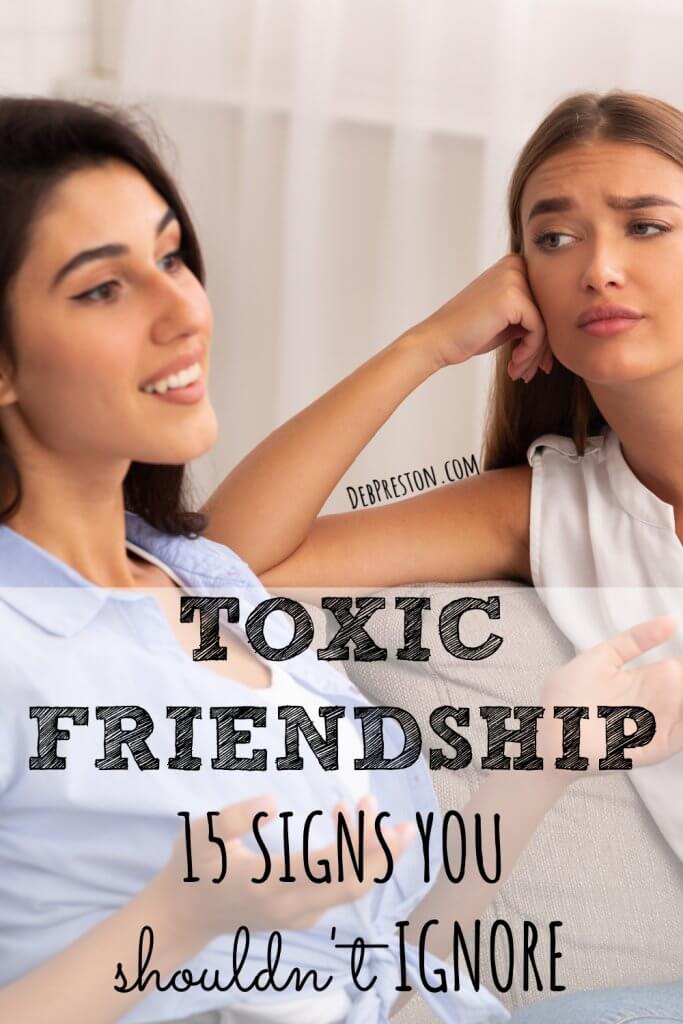
Toxic friendship signs are usually plentiful and relatively obvious in a toxic friendship. By learning how to recognize the signs and address them appropriately, you’ll be well on your way to building healthy and balanced friendships with others. You’ve got this!
P.S. Ready to break up with stress? Download our free guide to help you develop a game-changing stress management plan. Get yours free HERE!
Related Posts



Disclosure: While all opinions are our own, we are a participant in the Amazon Services LLC Associates Program and other affiliate advertising programs, designed to provide a means for us to earn fees by linking to Amazon.com and affiliated sites, at no additional cost to you.